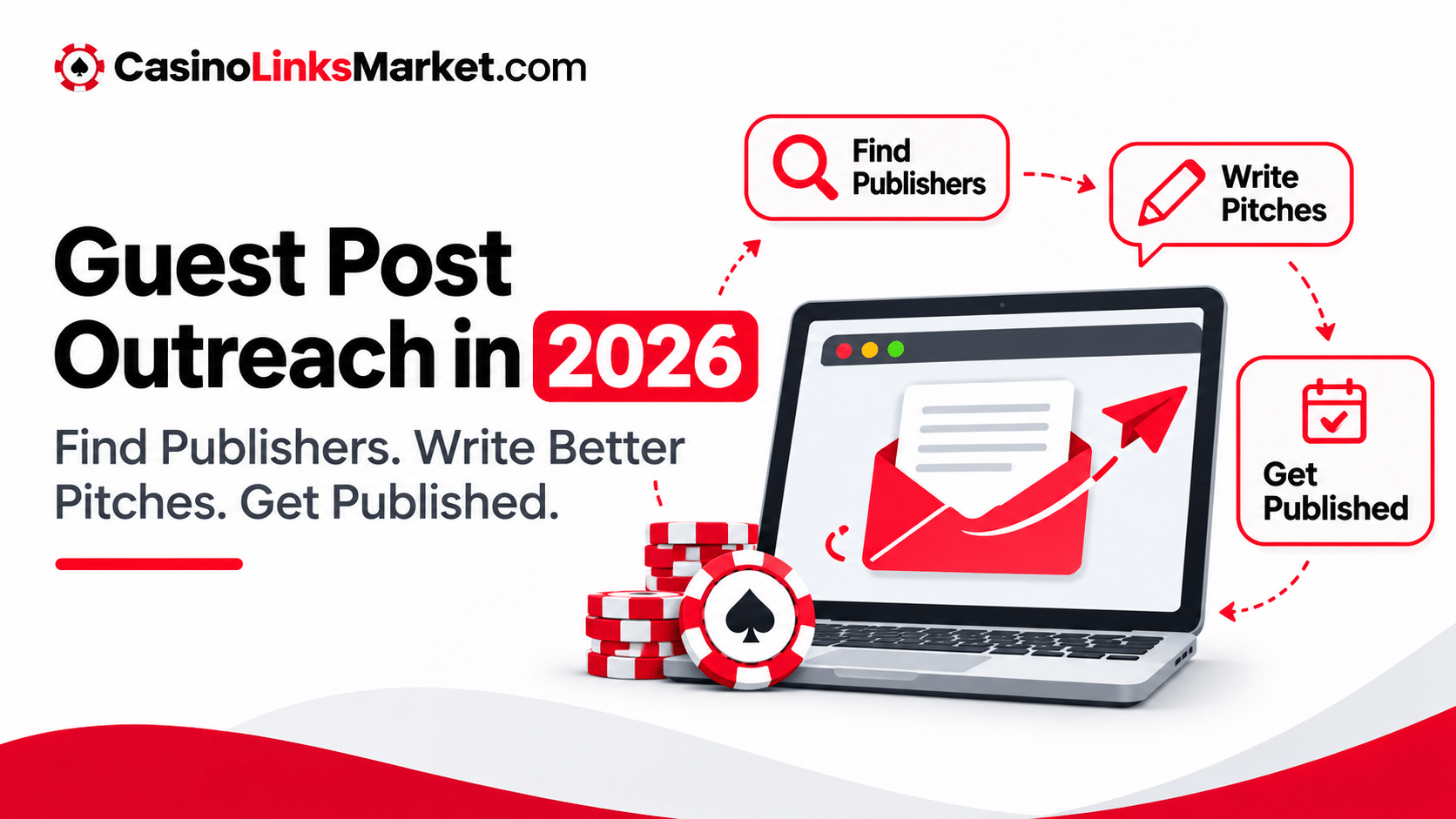
Guest Post Outreach in 2026: How to Find Publishers, Write Better Pitches, and Secure Quality Placements

Guest post outreach can be one of the most frustrating parts of SEO. You spend hours researching websites, finding email addresses, writing proposals, and following up with publishers, only to discover that many messages never receive a response.
The problem is not necessarily that guest posting has stopped working. More often, businesses approach outreach without a clear strategy, contact unsuitable publishers, or send generic messages that provide no compelling reason to respond.
Successful guest post outreach in 2026 requires relevant publisher research, thoughtful communication, strong editorial content, and consistent relationship management.
For businesses in highly competitive industries such as casino, iGaming, cryptocurrency, and finance, these considerations are especially important.
This guide explains how to develop an effective guest posting outreach process, from finding suitable publishers and contacting editors to negotiating placements, measuring performance, and deciding when a publisher marketplace may be more practical.
What Is Guest Post Outreach?
Guest post outreach is the process of identifying relevant websites and contacting their editors or owners to propose original content for publication.
The objective is to contribute something useful to an established publication while introducing your expertise, brand, or business to its audience.
A typical guest post outreach process involves:
- Researching websites that publish content related to your industry.
- Identifying their editorial requirements.
- Finding appropriate contact information.
- Preparing relevant article ideas.
- Sending personalized outreach emails.
- Following up when appropriate.
- Agreeing on publication terms.
- Delivering original, valuable content.
- Tracking published placements and results.
Guest posting can create opportunities for brand recognition, referral traffic, professional relationships, and naturally earned editorial backlinks.
However, guest posting designed primarily to manipulate search rankings can violate Google’s link spam policies. Paid placements should use appropriate sponsored or nofollow link attributes.
Understanding this distinction is essential when planning a long-term campaign.
Why Guest Post Outreach Still Matters in 2026
Search optimization continues to evolve, but reaching relevant audiences through established publications remains a useful marketing strategy.
Guest post outreach offers several advantages that businesses cannot always achieve through publishing exclusively on their own websites.
Reach an Established Audience
Building organic traffic on a new website often requires considerable time and resources.
Contributing an informative article to a publication with an existing readership can introduce your brand to people who have not previously encountered your business.
For example, a gaming software provider contributing an article about secure digital transactions to a technology publication may attract readers interested in payment systems and online platform security.
Build Professional Relationships
Strong publisher relationships can create opportunities beyond a single article.
Editors may invite reliable contributors to participate in future articles, provide expert commentary, or collaborate on industry-specific research.
For agencies managing multiple client campaigns, these relationships can also make future editorial coordination more efficient.
Establish Industry Expertise
Publishing detailed, accurate articles in relevant publications gives businesses opportunities to demonstrate knowledge.
A casino technology company might contribute educational content about responsible gaming systems, cybersecurity, or payment infrastructure.
Expertise is more convincing when the content offers genuinely useful explanations rather than repetitive promotional claims.
Generate Qualified Referral Traffic
A guest article can encourage interested readers to visit the contributor’s website.
When the audience is relevant, these visits may generate inquiries, newsletter registrations, or other meaningful conversions.
Unlike speculative ranking improvements, referral traffic can be measured directly using analytics.
Step 1: Find Relevant Guest Posting Websites
The first challenge in guest post outreach is identifying publications worth contacting.
A large prospect list is not necessarily a useful one. A smaller collection of relevant publishers can be easier to manage and may produce stronger editorial opportunities.
Use Google Search Operators
Search operators help identify websites with public guest contribution guidelines.
Examples include:
"write for us" + technology
"guest post guidelines" + finance
"become a contributor" + gaming
"submit an article" + business
"editorial guidelines" + sports
inurl:write-for-us digital marketing
intitle:"contribute" cybersecurity
These searches can reveal publications that openly accept outside contributions.
However, the existence of a submission page does not establish that a website is high-quality or that it accepts every commercial niche.
Always review its recent content and requirements.
Research Competitor Backlinks
Competitor backlink analysis is another useful source of publisher ideas.
Tools such as Ahrefs and Semrush can identify websites that mention or link to competitors.
Review these referring pages to understand what types of publications cover your industry.
Look for articles featuring expert interviews, original research, external contributors, or relevant industry commentary.
A competitor’s backlink does not mean the publication sells placements, but it may indicate editorial interest in your topic.
Explore Industry Publications
Search beyond websites explicitly advertising guest posting.
Many valuable editorial opportunities exist through industry associations, specialized blogs, independent news outlets, podcasts, and expert-led publications.
For iGaming businesses, potential topics may overlap with sports technology, financial services, software development, cybersecurity, and regulatory developments.
The goal is to find publications whose audiences have a genuine reason to care about your content.
Step 2: Evaluate Publishers Before Contacting Them
Sending outreach messages without reviewing the target websites can waste time and damage your sender reputation.
Before contacting an editor, assess whether the publication is appropriate for your campaign.
Review Organic Traffic
Estimated organic traffic can indicate whether a website has search visibility.
Use SEO tools to examine traffic trends, geographic distribution, and ranking keywords.
Do not assume that an estimated traffic figure represents verified first-party analytics.
Also consider whether the website attracts visitors interested in your industry.
Check Domain Rating and Authority
Domain Rating (DR) and Domain Authority (DA) are popular third-party SEO metrics.
They can help with initial comparisons, but they are not Google ranking factors.
A publication with a modest DR and highly relevant editorial coverage may offer more valuable exposure than a high-DR general website.
Assess Content Quality
Read several recent articles.
Check whether they provide useful information, follow consistent editorial standards, and cite credible sources where necessary.
Be cautious of publications containing large quantities of thin, unrelated, or repetitive promotional material.
Examine Publishing Activity
Determine whether the publication is still active.
Check recent posting dates, article categories, functioning pages, and evidence of editorial oversight.
Inactive websites or neglected contributor pages may be poor outreach targets.
Understand Commercial and Editorial Policies
Some publications accept only unpaid editorial contributions, while others offer sponsored content.
Clarify the publication’s policy before discussing pricing or links.
For gambling-related content, verify whether the publisher accepts the topic and whether the proposed material complies with applicable advertising laws.
Step 3: Find the Right Editorial Contact
Even a well-written proposal can be overlooked if it reaches the wrong person.
Generic inboxes may work for smaller websites, but larger publications often have dedicated editorial departments.
Suitable contacts may include the managing editor, content editor, partnerships manager, or website owner.
Review the publication’s contact page, contributor guidelines, editorial staff page, and official professional profiles.
When available, prioritize publicly listed professional contact information.
Avoid collecting personal email addresses that were not intended for business inquiries.
Why Contact Verification Matters
Incorrect email addresses cause delivery failures and create additional work.
Before launching an outreach campaign, verify address formatting and use reputable verification services where appropriate.
Tools such as Hunter and other business contact platforms can support the process, although no verification service can guarantee that a recipient will respond.
Maintain accurate contact records and avoid repeatedly emailing invalid addresses.
Step 4: Choose the Right Outreach Approach
Not every publisher should receive the same level of attention.
The outreach method should depend on the publication’s relevance, editorial requirements, and potential marketing value.
Targeted Personalized Outreach
For highly relevant or prominent publications, invest more time in understanding the editor’s interests.
Read recent articles, identify useful content gaps, and suggest ideas that complement the publisher’s existing coverage.
A thoughtful proposal can explain precisely why the article matters to the audience.
Structured Outreach for Larger Campaigns
Agencies often manage many potential publishing opportunities.
A structured workflow can improve efficiency through contact databases, reusable email frameworks, and tracking systems.
However, using a template should not mean sending identical messages indiscriminately.
Each recipient should receive a relevant proposal that reflects the publication’s editorial focus.
AI tools can assist with research and drafting, but personalized claims should always be checked before sending.
Step 5: Research Guest Post Topics Editors Actually Want
A strong topic proposal is often more important than a long introduction.
Editors want content that serves their readers.
Before pitching, review the publication’s existing categories, popular topics, and submission guidelines.
Look for subjects that are relevant but have not already been covered extensively.
Example Topics for Technology Publications
- How Digital Identity Verification Is Changing Online Platforms
- Five Cybersecurity Challenges Facing Digital Service Providers
- The Future of Secure Payment Infrastructure
Example Topics for Sports Publications
- How Data Analytics Is Changing Modern Football Coverage
- The Growing Role of Mobile Technology in Sports Media
- Why Understanding Sports Statistics Requires More Than Scorelines
Example Topics for iGaming Industry Publications
- Responsible Gambling Technology: Tools Supporting Player Protection
- How Payment Security Shapes Trust in Online Gaming Platforms
- What Gaming Businesses Should Consider Before Entering New Markets
These subjects are designed around reader interests rather than commercial keywords alone.
Offering two or three suitable article ideas can make it easier for editors to select an appropriate direction.
Step 6: Write a Guest Post Outreach Email That Encourages Replies
A guest post proposal should be concise, relevant, and easy to respond to.
Editors receive many requests, so an email that communicates its purpose immediately is more practical than a lengthy sales pitch.
Include a descriptive subject line, a genuine reason for contacting the publication, a brief explanation of your proposed contribution, and a clear question.
Guest Post Outreach Email Template
Subject: Article contribution ideas for [Website Name]
Hi [First Name],
I came across your publication while researching websites covering [industry or topic].
I noticed your coverage of [specific subject] and thought a few related article ideas might be valuable for your audience.
Here are three topics I’d be happy to contribute:
- [Relevant Topic One]
- [Relevant Topic Two]
- [Relevant Topic Three]
I can prepare an original, well-researched article tailored to your editorial requirements.
Would any of these topics be suitable for your publication?
Best regards,
[Your Name]
[Company Name]
Sponsored Guest Post Inquiry Template
Subject: Sponsored article inquiry for [Website Name]
Hi [First Name],
I’m reaching out to ask whether your publication currently accepts sponsored editorial content.
We’re exploring relevant publishing opportunities in [industry] and would appreciate some information about your requirements.
Could you share your publication pricing, accepted topics, editorial guidelines, and estimated turnaround time?
It would also be helpful to know your sponsored-link policy and whether you have any recent examples of suitable placements.
Thank you for your time.
Best regards,
[Your Name]
These templates should be adapted to each publisher. Avoid claiming that you enjoyed or read a particular article unless you actually reviewed it.
Step 7: Follow Up Without Annoying Publishers
A lack of response does not always mean an editor is uninterested.
Messages can be missed, delayed, or overlooked during busy publishing periods.
However, repeatedly sending the same request can harm professional relationships.
A practical starting sequence might be:
| Stage | Suggested timing | Action |
|---|---|---|
| Initial outreach | Day 1 | Send a personalized proposal |
| First follow-up | Day 4–5 | Briefly reference the original pitch |
| Final follow-up | Day 10–14 | Offer a relevant alternative or politely close the inquiry |
These intervals are suggested workflow guidelines, not guaranteed optimal sending times.
Example Follow-Up Email
Subject: Re: Article contribution ideas for [Website Name]
Hi [First Name],
Just following up on my earlier message about contributing an article to your publication.
I’d be happy to adjust the proposed topics to better fit your editorial calendar.
Please let me know if guest contributions are currently being considered.
Best regards,
[Your Name]
If the recipient declines, asks not to be contacted, or indicates that contributions are closed, respect that decision.
Avoid indefinite repeated follow-ups.
Step 8: Negotiate Publication Terms Clearly
After a publisher expresses interest, clarify the arrangement before commissioning content or making payment.
Important questions include the article’s subject, publication cost where applicable, content length, editorial review process, link policy, attribution requirements, and expected turnaround time.
For sponsored placements, confirm how the publisher labels advertising and qualifies paid links.
Google recommends rel="sponsored" for advertisements and other paid links, with nofollow also accepted.
Do not assume that a publisher offering a paid dofollow backlink makes that placement compliant with Google’s policies.
Special Considerations for Casino and Betting Content
For iGaming placements, ask whether the publisher accepts casino, sportsbook, affiliate, or gambling-industry topics.
Different publishers may have different restrictions.
A site that accepts educational articles about gaming technology may not accept promotional content encouraging participation in real-money gambling.
Also confirm applicable geographic restrictions, licensing requirements, age-related advertising rules, and permitted claims.
Step 9: Deliver High-Quality Guest Post Content
Once the publisher approves a topic, focus on producing an article that earns its place on the website.
Good guest content should answer a clear reader question, provide original insight, use accurate information, and follow the publication’s editorial standards.
Avoid producing multiple near-identical articles with only a few keywords changed.
Useful content may include expert explanations, practical frameworks, carefully verified statistics, or examples relevant to the publication.
Important Content Quality Checks
Before submission, verify that the article:
- Matches the approved subject and editorial requirements.
- Uses natural language and appropriate headings.
- Provides meaningful information rather than generic filler.
- Includes credible references when discussing technical or legal matters.
- Uses original or appropriately licensed visuals.
- Contains accurate brand descriptions and destination links.
- Avoids unsupported claims and exaggerated guarantees.
For paid content, ensure required disclosures and link attributes are addressed with the publisher.
An effective guest article should offer value even when readers do not click through to the contributor’s website.
Step 10: Track Guest Post Outreach Performance
Tracking helps turn outreach from a collection of emails into a measurable business process.
Record each publisher’s website, contact, outreach date, response, terms, and final result.
A simple spreadsheet or CRM can provide useful visibility across a campaign.
Essential Outreach Metrics
| Metric | What it measures |
|---|---|
| Email delivery rate | Percentage of messages accepted by receiving servers |
| Reply rate | Percentage of outreach messages receiving responses |
| Positive response rate | Percentage generating genuine publisher interest |
| Placement rate | Percentage resulting in published contributions |
| Average placement cost | Spending per completed paid placement |
| Turnaround time | Time between agreement and publication |
| Referral traffic | Visitors arriving from published articles |
| Conversion rate | Percentage of referred visitors completing a desired action |
For example, suppose an agency sends 100 properly targeted outreach messages, receives 20 replies, and secures 8 published articles.
Its reply rate would be 20%, while its placement rate would be 8%.
These are illustrative figures, not industry benchmarks.
The purpose of measurement is to understand which publishers and approaches produce useful results.
How to Use AI for Guest Post Outreach in 2026
AI can assist agencies with several repetitive aspects of outreach.
For example, it can help organize publisher research, classify responses, generate initial draft emails, summarize editorial requirements, and prepare follow-up suggestions.
A typical assisted workflow might involve collecting publicly available website information, identifying relevant article categories, generating a personalized draft, and presenting that draft for human review.
However, AI should not invent contact names, claim to have read nonexistent articles, or automatically agree to commercial terms without authorization.
Where Human Review Still Matters
Editorial negotiations, commercial commitments, regulatory questions, and uncertain publisher requirements should receive human attention.
For regulated industries such as gambling, human verification is particularly important because publishing rules and local laws vary.
The best approach uses AI to reduce repetitive administrative work while preserving accuracy, editorial judgment, and responsible communication.
Guest Post Outreach Tools Worth Considering
Several tools can support different stages of publisher research and outreach.
Ahrefs: Useful for reviewing backlink profiles, estimated organic traffic, referring domains, and competitor publications.
Semrush: Supports competitor research, organic visibility analysis, and keyword discovery.
Hunter: Helps locate and assess business email addresses for professional outreach.
Pitchbox: Provides outreach campaign management and relationship-tracking functionality.
Google Sheets: Offers a flexible, low-cost way to track publishers, replies, pricing, and placements.
These tools serve different purposes. The right combination depends on your campaign size and operational needs.
No software guarantees publication, editorial approval, or higher search rankings.
Guest Post Outreach vs. Guest Post Marketplaces
Manual outreach offers flexibility, but it can become resource-intensive.
Every publisher requires research, communication, editorial coordination, and follow-up.
For an agency managing multiple clients, these tasks may consume a significant portion of its available time.
A guest posting marketplace offers an alternative discovery and procurement workflow by organizing publishing opportunities in one location.
Comparing the Two Approaches
| Factor | Manual outreach | Guest post marketplace |
|---|---|---|
| Publisher discovery | Independent research | Browse available listings |
| Contact management | Managed individually | Often centralized |
| Pricing | Usually requested or negotiated | May be displayed or quoted |
| Editorial flexibility | Depends on direct agreement | Depends on marketplace and publisher |
| Time investment | More manual work | Potentially less discovery work |
| Publisher relationships | Built directly | May be mediated by the platform |
Neither approach automatically delivers better placements.
Manual outreach may be more suitable for exclusive editorial relationships, while a marketplace can simplify research and coordination for businesses evaluating multiple publication opportunities.
Simplifying Publisher Research With Casino Links Market
For SEO professionals, digital marketing agencies, and businesses operating in competitive niches, identifying appropriate publishers is often one of the most time-consuming stages of content placement.
Casino Links Market offers a marketplace-oriented approach to exploring guest posting opportunities.
Businesses looking for casino, iGaming, or other relevant publishing opportunities can use available publisher information as a starting point when comparing potential placements.
When evaluating any listing, consider its niche relevance, geographic audience, traffic estimates, publishing requirements, pricing, and advertising policies.
Publisher availability alone should never replace independent due diligence.
For gambling-related campaigns, confirm the applicable editorial and regulatory restrictions before placing an order.
The objective should be to choose publications that make sense for the intended audience and business goals rather than focusing exclusively on acquiring a particular number of links.
Common Guest Post Outreach Mistakes to Avoid
Guest post outreach frequently underperforms when teams prioritize activity over relevance.
One common mistake is building an enormous prospect list without confirming whether the websites are suitable.
Another is sending generic emails that fail to explain why the content matters to the publication.
Other problems include contacting the wrong person, ignoring editorial requirements, proposing unrelated topics, repeatedly following up after rejection, and failing to record negotiation details.
For paid placements, neglecting link attributes and advertising disclosures can also create search policy risks.
Avoid these problems by making publisher relevance, clear communication, and accurate records central to your process.
Frequently Asked Questions About Guest Post Outreach
What is guest post outreach in SEO?
Guest post outreach involves contacting publishers to propose relevant content contributions. It can help businesses reach new audiences, build professional relationships, and potentially earn editorial references.
How do I find websites that accept guest posts?
Use relevant Google searches, contributor pages, industry publication research, and competitor backlink analysis. Review each publication’s editorial standards before contacting its team.
How many outreach emails should I send daily?
There is no universal ideal number. Focus on relevant, permission-conscious outreach rather than arbitrary sending volume. Follow your email provider’s requirements and applicable anti-spam laws.
What should a guest post outreach email include?
A useful email includes a clear subject line, relevant context, concise article ideas, and a simple question that the editor can answer.
How long should I wait before following up?
Waiting around three to five business days can be a reasonable starting point, depending on the publication. Respect any response, opt-out, or published communication preference.
Can AI automate guest post outreach?
AI can help research publishers, organize information, and draft messages. Human oversight remains important for commercial negotiations, accuracy, and regulated subjects.
Is paid guest posting allowed by Google?
Paid guest posting can be legitimate advertising, but buying links to manipulate rankings violates Google’s spam policies. Google recommends qualifying paid links with rel="sponsored" or rel="nofollow".
Are guest post marketplaces better than manual outreach?
Marketplaces can reduce the work involved in discovering and comparing publishers, while manual outreach offers more direct control over relationships. The better choice depends on budget, editorial requirements, and campaign objectives.
Final Thoughts
Guest post outreach in 2026 is not simply about sending large numbers of emails and waiting for backlinks.
It requires understanding publisher audiences, selecting relevant websites, creating useful content, communicating professionally, and measuring real marketing outcomes.
The most sustainable approach prioritizes editorial quality and meaningful relationships over shortcuts.
For casino and iGaming businesses, responsible publisher selection and attention to regulatory requirements are especially important.
Whether you manage outreach manually or use a publishing marketplace, the fundamental principles remain the same: choose relevant opportunities, communicate clearly, deliver useful content, and evaluate the results.
Looking for publishing opportunities for your next campaign?
Explore Casino Links Market and begin comparing relevant publisher options for your content marketing and guest posting strategy.
Further reading